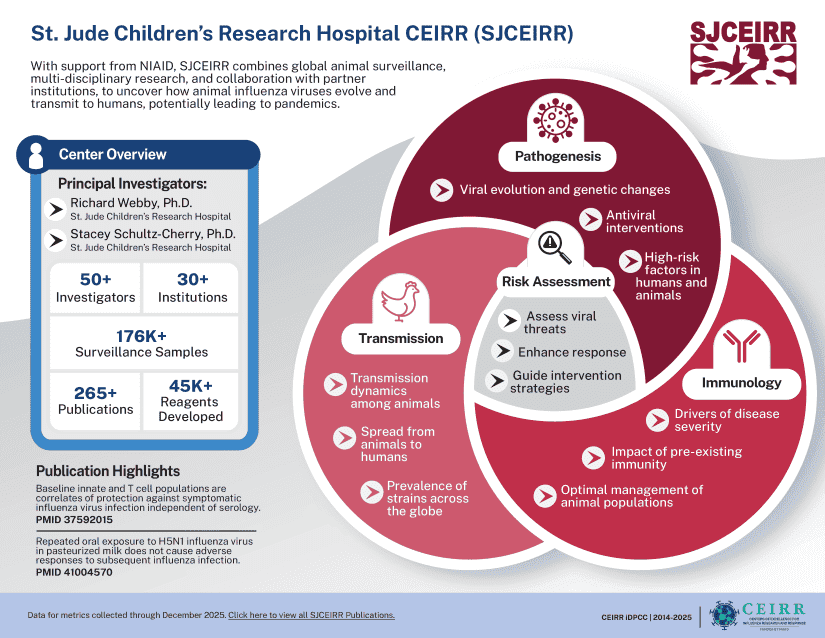
The CEIRR Network studies the natural history, transmission, and pathogenesis of influenza and other respiratory viruses of pandemic potential. The seven multidisciplinary and collaborative research Centers provide an international research infrastructure to address outbreaks from influenza and other respiratory viruses. One such Center, the St. Jude Children’s Research Hospital CEIRR (SJCEIRR), uncovers how animal influenza viruses evolve and transmit to humans by combining global animal surveillance, multi-disciplinary research, and collaboration with partner institutions. Under the leadership of Richard Webby, Ph.D., and Stacey Schultz-Cherry, Ph.D., both at St. Jude Children’s Research Hospital, SJCEIRR’s mission covers four major research arms:
- Pathogenesis
- Transmission
- Immunology
- Risk Assessment
St. Jude has played an important role in influenza research since the original CEIRS contract that started in 2007 under the leadership of Dr. Robert Webster when the Center was known as St. Jude CEIRS. Interestingly, the original CEIRS contract was an extension of other influenza research awarded to St. Jude by the National Institute of Allergy and Infectious Diseases (NIAID) in 1999. In response to the 1997 H5N1 outbreak in Hong Kong, the contract established an influenza surveillance program in aquatic birds and live bird markets in Hong Kong, along with studying the natural history of influenza viruses that had the potential to cause a pandemic. With the 1999 contract, the St. Jude team also trained investigators in animal influenza surveillance techniques, developed tests for viral detection, and provided seed vaccines to NIAID. Today, SJCEIRR is helmed by Drs. Webby and Schultz-Cherry. Though the contracts and personnel have shifted, Dr. Schultz-Cherry notes, “the mission of SJCEIRR has remained the same - unravel critical mysteries in the emergence and spread of influenza viruses.”
Simply put, to unravel the mysteries of influenza biology, SJCEIRR investigators track flu viruses around the world and study how they work. This can take a variety of approaches, like understanding how an influenza virus causes disease, how it evolves over time, how it spreads among animals and humans, or how it interacts with an animal’s or human’s immune system. Dr. Schultz-Cherry says that three questions help ground SJCEIRR’s research projects:
- How do new viruses arise?
- What mutations enable new viruses to spread among the human population and cause a new outbreak?
- What are the options for controlling them?
Answering these questions can help scientists understand how new outbreaks may begin and what intervention strategies can minimize the harm to animal and human health.
Today, more than 50 investigators and collaborators contribute to SJCEIRR’s mission, publishing over 270 publications on influenza virus evolution and transmission, as well as the impact of pre-existing immunity and high-risk factors for disease in humans and animals. Additionally, SJCEIRR investigators generated more than 5,600 freely available reagents and ferret reagents to advance influenza and other viral research. When asked what recent discovery from their Center excited the SJCEIRR PI’s most, Dr. Schultz-Cherry expressed, “That’s a tough question. We are proud of all our Center investigators and laboratory discoveries. It’s hard to choose just one.”
Looking toward the future, Dr. Schultz-Cherry wants to see the CEIRR Program address critical high-risk/high-reward topics and questions in the field that can’t be funded by traditional grant funding mechanisms but may be possible under a future CEIRR contract. She also looks forward to continued development of resources and reagents to advance the field of influenza virology.


The iDPCC interviewed Drs. Richard Webby (RW) and Stacey Schultz-Cherry (SSC) to learn more about their experiences:
1. What is one thing on your bucket list?
RW: Score the game winning try for the All Blacks over the Springboks. Beginning to think it’s a little unlikely, however.
SSC: Travel the world and experience new cultures. Rescue every stray animal I see, especially the cats and mini farm animals.
2. Do you have advice for early career scientists on career longevity in research?
RW: Don’t be too concerned that your experiences are different from others and don’t take too much stock in “advice from others”. There are many different paths to a career in science research.
SSC: Grow a thick skin. Academic research is not for the faint hearted. Develop a network of trusted colleagues.
3. What is your favorite country to attend a conference… or a vacation?
RW: Anywhere except Australia. Far too many Australians.
SSC: London or the greater British Isles.
4. Are you a morning person or a night person?
RW: Morning
SSC: Morning