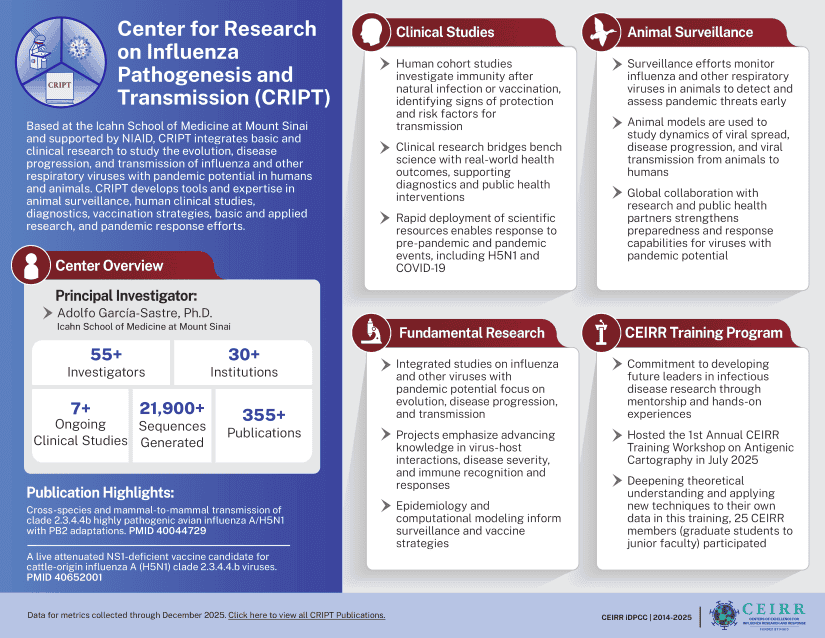
The CEIRR Network studies the natural history, transmission, and pathogenesis of influenza and other respiratory viruses of pandemic potential. The seven multidisciplinary and collaborative research Centers provide an international research infrastructure to address respiratory viral outbreaks. One such Center, the Center for Research on Influenza Pathogenesis and Transmission (CRIPT), seeks to develop tools and expertise in animal surveillance, human clinical studies, diagnostics, vaccination strategies, basic and applied research, and pandemic response efforts. Under the leadership of Adolfo García-Sastre, Ph.D. at the Icahn School of Medicine at Mount Sinai, CRIPT’s studies are categorized into three major sectors:
- Clinical Studies
- Animal Surveillance
- Fundamental Research
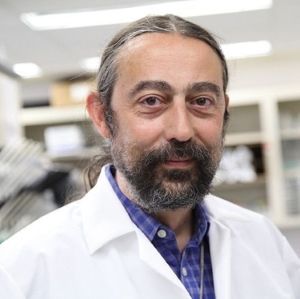
Dr. García-Sastre has led CRIPT since the original CEIRS contract that started in 2007, though the Center was originally named CRIP. He recalled a conversation with Drs. Ron Fouchier and Daniel Perez about keeping an eye out for program project grants or inter-collaborative grants to study influenza viruses. He noted that “a few months later, the call for the first CEIRS proposal was announced.” The three of them applied together and continue to collaborate in CRIPT today.
In describing CRIPT’s scientific aims, Dr. García-Sastre says, “We are flu fighters, and our aim is to get rid of influenza by knowing the weaknesses of our enemy, the influenza virus, and to counter-attack and defend against the virus.” In practice, CRIPT researchers study the evolution, pathogenesis, and transmission of influenza, and other emerging respiratory pathogens, to identify potential weak points and to develop prevention and treatment strategies. The Center’s clinical human cohort studies examine immune responses after infection or vaccination and bridge foundational science with real-world health outcomes. The surveillance work focuses on monitoring the emergence, pathogenesis, and transmission of viruses in animals to detect pandemic threats early. Finally, CRIPT’s fundamental research efforts tackle virus-host interactions, virulence, antigenicity, and immune responses, among other projects, to link to surveillance and clinical outcomes.
Today, more than 55 investigators and collaborators contribute to CRIPT’s mission, publishing over 320 publications on the pathogenesis and transmission of influenza and other emerging viruses. Dr. García-Sastre shared two recent publications that represent CRIPT’s priorities: finding genetic risk factors in the virus that expand host range and novel vaccines to mitigate potential pandemic viruses. However, Dr. García-Sastre wanted to emphasize that many other publications could have been selected that represent the same principles and that he is impressed by all the scholarship from the Center. One recent finding that piques his personal interests is the discovery of a new receptor for some influenza viruses – MHC Class II.
In addition to its rigorous research studies, CRIPT holds another major responsibility – hosting the CEIRR Training Program. In past years, CRIPT coordinated pairings between trainees and mentors for short stays in the mentor’s lab to learn a particular technique. The program took on a different shape this year by holding an in-person Training Workshop on Antigenic Cartography for 25 CEIRR members. After this successful first year, the CRIPT team is excited to continue offering training workshops in the coming years.
Envisioning the future, Dr. García-Sastre would love to see the CEIRR Program “expand to other zoonotic pathogens” beyond the predominant emphasis now on influenza and SARS-CoV-2. He aims to “stop all zoonotic viruses,” and looks forward to contributing his expertise to further prevention, treatment, and pandemic response strategies.
The iDPCC interviewed Dr. García-Sastre to learn more about his experiences:
1. Who/what inspired you to go into science in general?
A. My high school biology teacher.
2. What is one thing on your bucket list?
A. To walk El Camino de Santiago.
3. How has your career trajectory changed over time?
A. First I wanted to study insects, and I quickly changed to viruses in college, but I still collect insects.
4. Do you have advice for early career scientists on career longevity in research?
A. Don’t lose your confidence if you are excited about research. And if you are not excited, change, research is not for you.
5. What technique, skill, or knowledge are you the “go to” person for in your field?
A. Molecular biology of negative strand RNA viruses.
6. Do you have any hobbies or special interests that you'd like to share?
A. Collecting insects. I also love horror movies, heavy metal music, and classic novels.
7. What is your favorite conference that you attended?
A. Options for the Control of Influenza.
8. What is your favorite country to attend a conference… or a vacation?
A. Spain
9. Are you a morning person or a night person?
A. Both