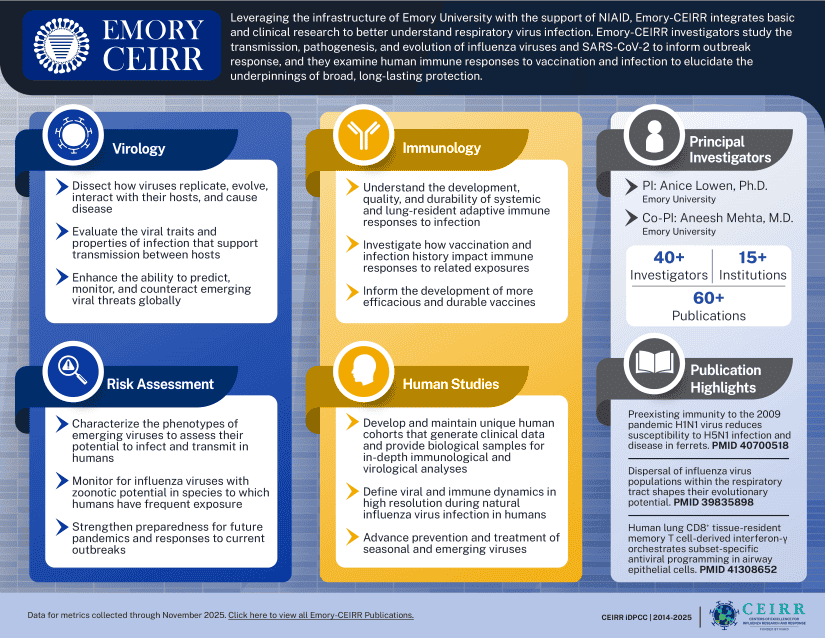
The CEIRR Network aims to predict, prevent, and respond to viral outbreaks by studying the natural history, transmission, and pathogenesis of influenza and other respiratory viruses of pandemic potential. Seven Centers provide a multidisciplinary and collaborative international research infrastructure to address respiratory viral outbreaks in real time. One such Center, the Emory University Center of Excellence for Influenza Research and Response (Emory-CEIRR), integrates basic and clinical research to better understand respiratory virus infection. Emory-CEIRR investigators study the transmission, pathogenesis, and evolution of influenza and SARS-CoV-2 to inform outbreak response strategies, and they examine human immune responses to vaccination and infection to elucidate the underpinnings of broad, long-lasting protection. Under the leadership of Anice Lowen, Ph.D., and Aneesh Mehta, M.D., both at Emory University, Emory-CEIRR’s investigations cover four major themes:
- Virology
- Immunology
- Risk Assessment
- Human Studies
Emory University investigators have contributed to CEIRR’s mission since the original CEIRS contract in 2007, known then as the Influenza Pathogenesis and Immunology Research Center (IPIRC) under the leadership of the late Richard Compans, Ph.D., a forefather of influenza virology. The IPIRC became Emory-UGA CEIRS from 2014-2021 and was led by Walter Orenstein, M.D., and Dr. Lowen served as a Co-Principal Investigator (co-PI) in the later years of the contract. Under CEIRR, Emory and UGA split into what is now Emory-CEIRR and CIDER. After Dr. Orenstein’s retirement in August of 2023, Dr. Lowen assumed the role of lead PI of Emory-CEIRR, and Dr. Mehta began serving as the co-PI.
To summarize Emory-CEIRR’s mission, Drs. Lowen and Mehta shared, “The scientists of the Emory-CEIRR work to understand the virus that causes Influenza and how our bodies respond to it.” They go on to explain that the more than 40 Emory-CEIRR researchers study how the flu virus gets into cells, makes more copies of itself, and spreads within an individual and from one individual to another. But they don’t just study the virus. The researchers explore how the human immune system detects flu infection and then protects against future infections, which is particularly important for designing vaccines. Drs. Lowen and Mehta note that Emory-CEIRR scientists “do critical research on influenza viruses that circulate in birds, pigs, and other non-human hosts, to understand the risk of these viruses causing a pandemic.” This work contributes to CEIRR’s Risk Assessment Pipeline (RAP), also led by Dr. Lowen, where Emory-CEIRR collaborates with other Centers to “respond to influenza outbreaks by performing research that can inform public health efforts to limit viral spread.”
Of the more than 60 publications from the Emory-CEIRR team, several recent discoveries piqued Dr. Lowen’s and Dr. Mehta’s interests that they wanted to highlight:

- Pandemic H1N1 infection protecting ferrets against H5N1
- Substantial viral diversity transmitting to recipients and then contracting during the establishment of infection
- Human lung tissue-resident memory T cells coordinate early mucosal defense through interferon-y programming
- Transmission of H5N1 among South American sea lions
- Insight into the role of waning immunity in driving respiratory virus evolution and reinfection
Looking ahead, Dr. Lowen reflected, “There is much we don’t understand, and I worry that too much focus on monitoring change in known phenotypes will leave us vulnerable to surprise.” Because of this concern, she would like to see CEIRR prioritize the discovery of some fundamentals, including: 1) processes that shape infection and immune control at the cellular and within-host levels, 2) transmission at the between-host level, and 3) viral dynamics at the population level. Dr. Lowen stresses that “discovery efforts designed to further understanding of viral prevalence in non-human hosts, host-range expansion, viral evolution, and immune protection are especially important,” to CEIRR’s overall mission of pandemic preparedness and response to influenza and other respiratory viruses.
The iDPCC interviewed Dr. Anice Lowen to learn more about her experiences:
1. Who/what inspired you to go into science in general?
A. My mom. She was a scientist and gave me a window into the world of research from a young age.
2. How has your career trajectory changed over time?
A. When I was a kid I wanted to be an author (of novels). I still enjoy writing and my career affords me plenty of opportunities to write, so I guess it worked out.
3. Do you have advice for early career scientists on career longevity in research?
A. Work hard, but keep it fun by pursuing research questions that excite you.
4. What technique, skill, or knowledge are you the “go to” person for in your field?
A. Reassortment
5. Do you have any hobbies or special interests that you'd like to share?
A. Martial arts, kayaking
6. What is your favorite conference that you attended?
A. The Negative Strand RNA Virus meeting (NSV) 2025
7. What is your favorite country to attend a conference… or a vacation?
A. Italy
8. Are you a morning person or a night person?
A. Morning