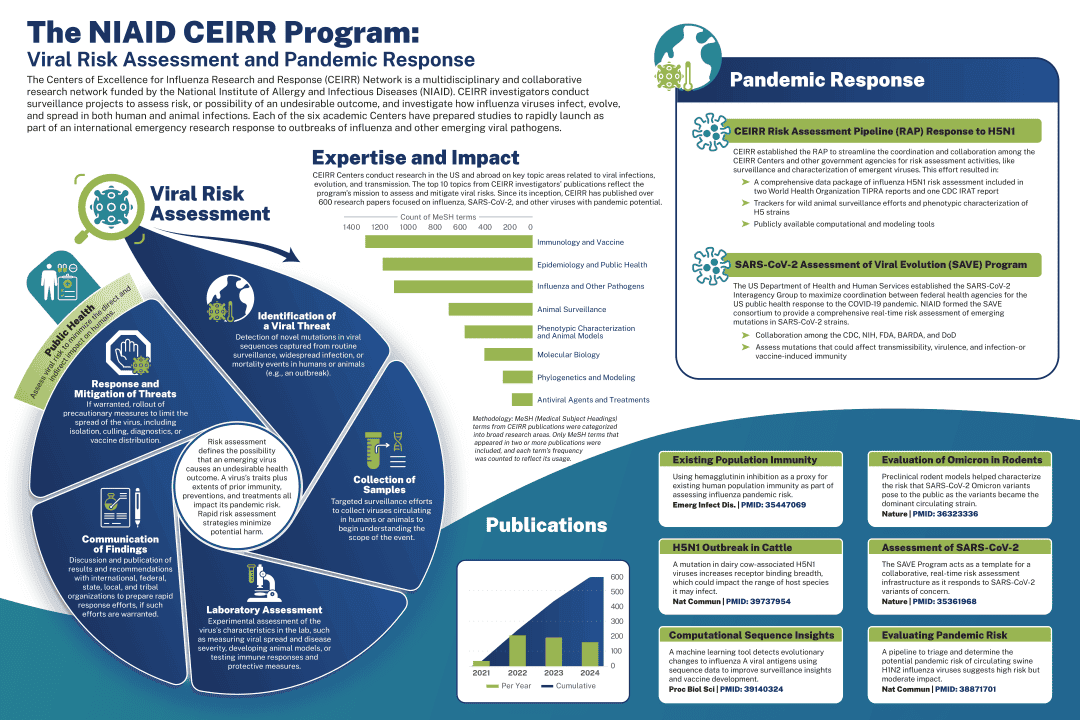
The National Institute of Allergy and Infectious Diseases (NIAID) funds the Centers of Excellence for Influenza Research and Response (CEIRR) Program, a multidisciplinary and collaborative research network that studies the natural history, transmission and pathogenesis of influenza and other respiratory viruses. A particular emphasis of CEIRR’s network of investigators is viral risk assessment, or the characterization of how a virus may cause an undesirable health outcome to humans or animals. The CEIRR Network is organized into six academic research Centers that generate data on influenza biology, immunology, and epidemiology, among other topics, while also preparing emergency response infrastructure to address influenza outbreaks.
CEIRR’s viral risk assessment strategy involves identifying a viral threat, collecting samples through targeted surveillance efforts, assessing the virus’s characteristics in the laboratory, and communicating their findings to response organizations and the wider scientific community. CEIRR’s approach is iterative in that new viral variants that may emerge are characterized during response efforts which may affect the overall risk assessment of an event. CEIRR’s expertise in responding to past outbreaks allows investigators to better prepare for future outbreaks. The preparedness infrastructure is crucial because rapidly deploying risk assessment strategies will minimize potential harm.
Two key collaborations that CEIRR investigators contribute to are the CEIRR Risk Assessment Pipeline (RAP) and the SARS-CoV-2 Assessment of Viral Evolution (SAVE) Program. CEIRR established the RAP to characterize emerging viruses, like during the bovine H5N1 outbreak, and coordinate activities among the CEIRR Centers and relay findings to other government response agencies. The SAVE Program was formed in 2020 by NIAID to coordinate real-time risk assessment of emerging mutations in SARS-CoV-2 strains among several federal health agencies. Both programs have improved national and international collaboration, streamlined resources and knowledge sharing, and generated data to contribute to ongoing risk assessments completed by public health agencies.
Alongside preparing and responding to viral threats, CEIRR investigators have published over 940 cutting-edge research manuscripts to further the scientific community’s understanding of influenza biology, risk factors, treatment strategies, and more. Including CEIRS, an earlier iteration of the program that began in 2007, the publication count surpasses 3,800. Its influenza and viral risk assessment expertise positions the CEIRR Program to impactfully investigate emerging viruses, assess risk, prepare for emergencies, and rapidly respond to threats to minimize harm to animals and humans around the world.