NIAID CEIRR Risk Assessment Pipeline (RAP)
RAP Sub-groups
Domestic Animal Surveillance
The Domestic Animal Surveillance sub-group examines influenza viruses in animals that live in close contact with people or agricultural systems, where spillover events can have major public health consequences. Their work is especially important in species such as swine, poultry, and now dairy cattle, where surveillance can directly inform response strategies and risk mitigation efforts.
Wild Animal Surveillance
The Wild Animal Surveillance sub-group focuses on identifying and tracking viruses circulating in free-living animal populations, especially species that serve as reservoirs or intermediate hosts. By studying how viruses move through wild birds and other animals, this group helps define the ecological context in which new threats emerge.
Phylodynamics and Computational Modeling
The Phylodynamics and Computational Modeling sub-group uses genetic sequence data and epidemiologic methods to understand how viruses evolve, spread, and adapt across hosts and settings. By analyzing viral lineages and modeling transmission patterns, this team helps place emerging strains into a broader evolutionary and public health context.
Phenotypic Characterization
The Phenotypic Characterization sub-group investigates how viruses behave biologically, including traits that may influence disease severity, host adaptation, transmissibility, immune escape, and response to treatment. Through laboratory experiments, this group tests whether viruses circulating in nature are acquiring characteristics associated with greater risk to humans or animals.
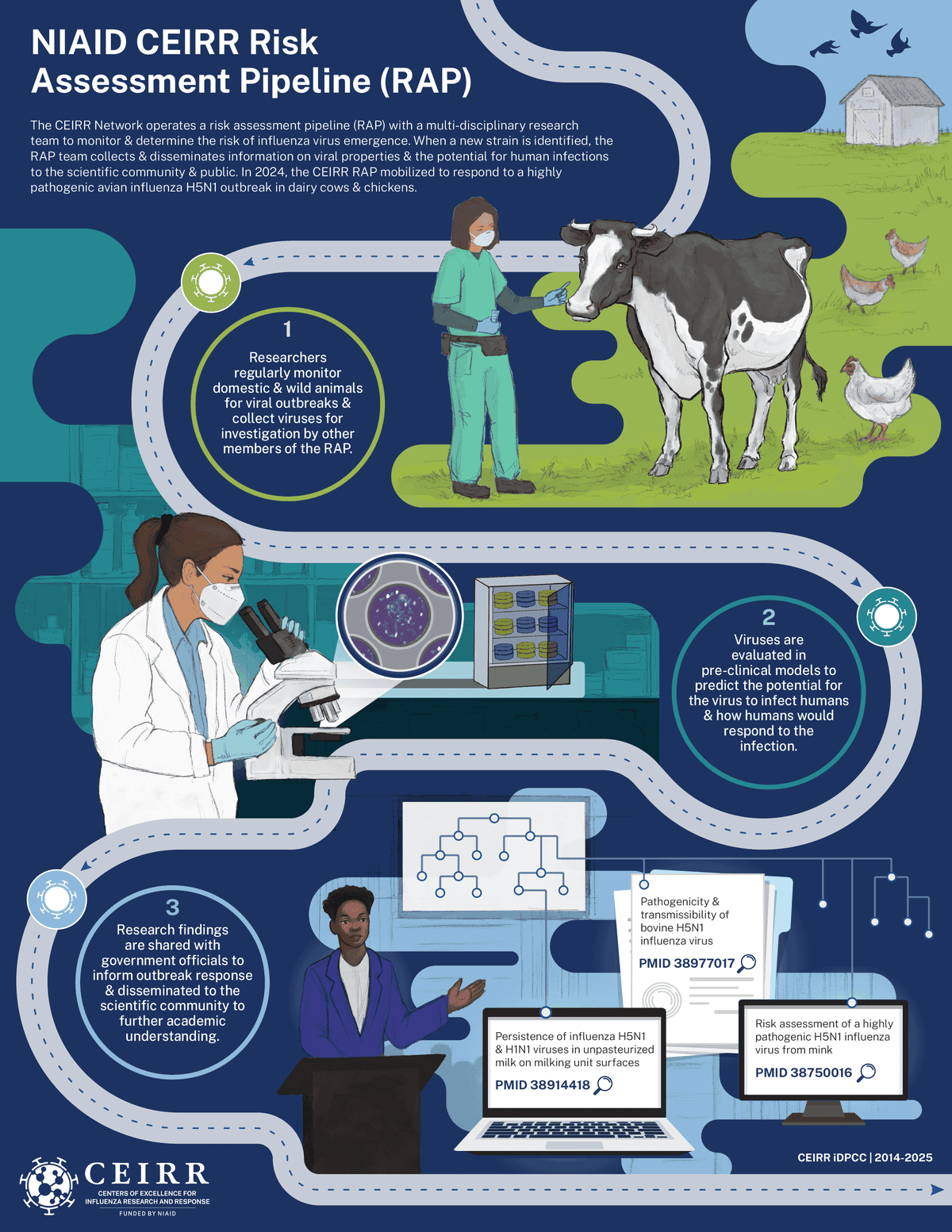
“CEIRR Infobyte: Risk Assessment Pipeline” Infobyte. To view a full-size PDF version, click the image above.
RAP Data Packages
| Title | Description | Link |
|---|---|---|
| Assessment of the Pandemic Potential of H9N2 B4.7.2 and B4.7.4 Influenza A Viruses | Published February 13th, 2026 | Download PDF |
| Assessment of the Pandemic Potential of 2.3.4.4b H5N1 Influenza Viruses of the D1.1 genotype | Published July 7th, 2025 | Download PDF |
| Assessment of the Pandemic Potential of Swine A(H1) 1B.2 Influenza Viruses | Published January 10th, 2025 | Download PDF |
| Assessment of the Pandemic Potential of 2.3.4.4b H5N1 Influenza Viruses | Published November 14th, 2024 | Download PDF |