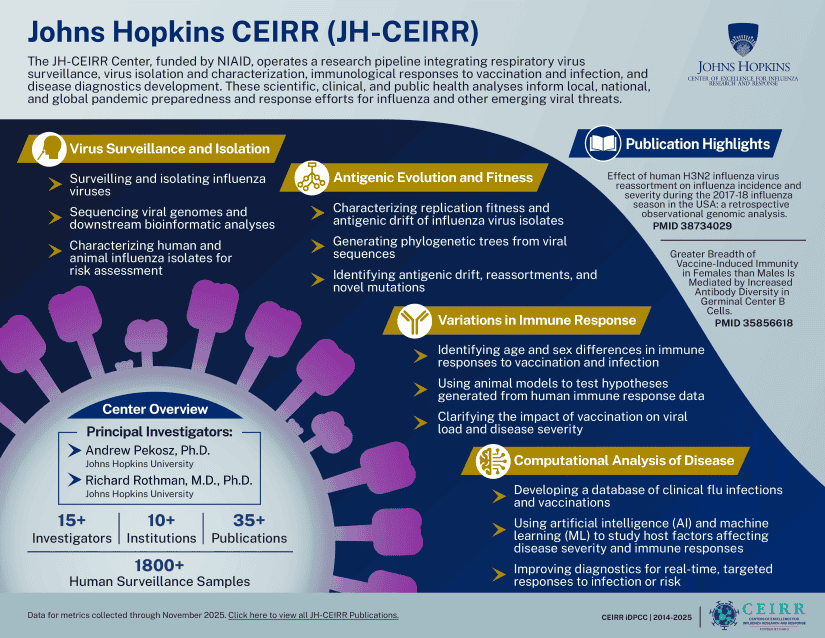
The CEIRR Network studies the natural history, transmission, and pathogenesis of influenza and other respiratory viruses that have the potential to cause seasonal disease and potentially new outbreaks. The seven multidisciplinary and collaborative research Centers provide an international research infrastructure to address respiratory viral outbreaks. One such Center, the Johns Hopkins University CEIRR (JH-CEIRR), operates a research pipeline integrating respiratory virus surveillance, virus isolation and characterization, immunological responses to vaccination and infection, and disease diagnostics development. Under the leadership of Andrew Pekosz, Ph.D. and Richard Rothman, M.D., Ph.D., both at Johns Hopkins University, JH-CEIRR’s studies cover four major themes:
- Virus Surveillance and Isolation
- Antigenic Evolution and Fitness
- Variations in Immune Response
- Computational Analysis of Disease
Dr. Pekosz was recruited to Johns Hopkins University by the late Diane Griffin, M.D., Ph.D., in part to establish an influenza research presence at the university. In parallel, Dr. Rothman was working on diagnostics for infectious diseases with a biodefense program. At the behest of Dr. Griffin, Drs. Pekosz and Rothman began discussing opportunities to continue studying influenza and developing diagnostics. Drawing on Dr. Rothman’s clinical and diagnostic experience and Dr. Pekosz’s basic science and public health expertise, they began strategizing on a pipeline to better understand and respond to seasonal influenza. The two identified additional investigators to join the effort and eventually secured funding from the National Institute of Allergy and Infectious Diseases (NIAID) to form JH-CEIRR, which was originally called JH-CEIRS under the original CEIRS contract.
When asked about JH-CEIRR’s scientific aims, Dr. Pekosz took a step back to emphasize that “influenza is more than a bad cold… it causes tens of thousands of deaths a year and hundreds of thousands of hospitalizations every year in the US alone.” JH-CEIRR researchers aim to drastically reduce these negative health impacts of influenza by:
- Improving diagnostic tools to detect the virus earlier
- Identifying factors in individuals that increase their risk of developing severe disease
- Determining how to boost immune responses after vaccination
- Predicting if an emerging influenza strain strengthened its replication fitness and thereby increased its ability to infect or cause disease
The Center’s collaborative approach combines scientific, clinical, and public health analyses to improve how local, national, and global organizations prepare for and respond to influenza viruses seasonally and during outbreaks.
Today, JH-CEIRR’s research pipeline is comprised of more than 15 investigators and has generated over 35 publications on the evolution and pathogenesis of influenza, variations in immune responses to influenza infection and vaccination, and improving diagnostics. A unique strength of JH-CEIRR’s pipeline focuses on computational analysis using artificial intelligence (AI) and machine learning (ML) to study host factors that affect disease severity and immune responses. Dr. Pekosz shared that he’s particularly excited by JH-CEIRR’s investigators’ ability to “identify virus mutations or recombination events that impact disease severity and spread in the population.” He’s fascinated by how an influenza virus changes a basic trait, like its ability to replicate or form a plaque in the lab, and is simultaneously able to evade pre-existing immune responses, which ultimately results in a viral strain that may cause more infections or more severe disease in a population.


Looking forward, Dr. Pekosz is interested in an expansion of CEIRR’s research efforts applied to all respiratory viruses. He envisions a future where the field leverages their expertise on influenza to study other respiratory viruses, especially those that have the potential to cause new outbreaks. From his view, “we have the skillsets in the Network to make a difference with all respiratory virus infections, not just influenza.”
The iDPCC interviewed Dr. Andrew Pekosz to learn more about his experiences:
1. Who/what inspired you to go into science in general?
It was really about having great high school teachers – both science and non-science – who encouraged me to use logic and reason to solve problems. That led me to focus in on science research and when I found a great virology lab as an undergraduate, I was hooked for life.
2. What is one thing on your bucket list?
To sing in a Broadway musical.
3. How has your career trajectory changed over time?
I’ve been very fortunate to have a pretty straightforward career trajectory. At every stage of my career and education, I focused in on what I loved to do and tried to find the best places to do that.
4. Do you have advice for early career scientists on career longevity in research?
It all starts with loving what you do. You then just have to follow the virus and it will continually show you interesting and important things you should investigate.
5. Do you have any hobbies or special interests that you'd like to share?
I tend to obsess about Premier League Soccer (its actually Football) and Japanese giant monster movies (think Godzilla).
6. What is your favorite conference that you attended?
The Negative Strand RNA Virus Conference is always great – a perfect mix of science and socializing.
7. What is your favorite country to attend a conference… or a vacation?
I love visiting England and always combine both when I’m there.
8. Are you a morning person or a night person?
Both! Sleep is overrated…