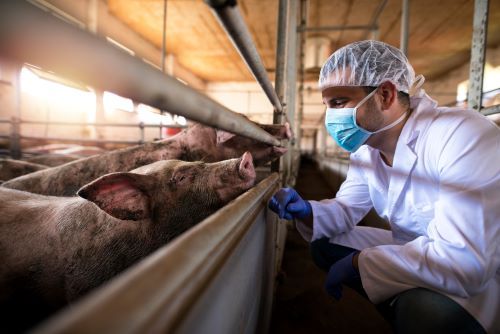
Penn-CEIRR researchers Phillip Gauger, D.V.M, Ph.D., Amy Baker, D.V.M., Ph.D., and colleagues recently investigated the presence of Influenza A Virus (IAV) at the farm level in both swine and in human workers. The results of their active surveillance work were published in Viruses. IAV causes significant economic loss for pig producers due primarily to reduced weight gain. IAV is also a potential and continuous threat to public health and has contributed to previous human influenza outbreaks. Swine are unique mixing vessels, able to be infected with both avian and human influenza viruses, making them a population uniquely capable of generating new IAVs. One of the most prominent examples of this effect was the H1N1 pandemic in 2009 which included avian-, swine-, and human-origin strains.
Due to swine harboring unique IAV strains with potential to transmit across species, humans that work on swine farms play a critical role in bidirectional transmission dynamics. Past studies have shown that occupational exposure increased farm employees’ risk of IAV infection from swine. As such, the shared environment between swine and humans must be examined at the farm level to better understand the dynamics of IAV at the human-swine interface with an end goal of optimizing surveillance and control strategies.
To fill this gap, Penn-CEIRR researchers tested pigs and farm employees at breeding farms and their respective nurseries to assess IAV detection and diversity over time. Farm employees and swine were tested monthly for the presence of IAV, and isolates were sequenced to better understand the strains of IAV present and how IAV clades are evolving. The authors also conducted surveys of farm workers to better understand existing biosecurity and management practices.
Among surveyed farm employees, only 29.2% reported receiving the IAV vaccine within the past 12 months, a rate much lower than the reported national average (46.9%). During the monthly active surveillance, IAV was detected in 0.9% of employees when sampled at work. Additionally, three cases of seasonal human IAV were detected in farm employees, but no direct evidence of transmission to swine was observed. Importantly, sequencing revealed the presences of a strain of IAV - H3.1990.4 - that the current vaccine is unlikely to offer protection against.
This study reveals that it is essential to include swine and farm employees in influenza surveillance and for said employees to receive routine seasonal influenza vaccination. Additionally, including sequencing in surveillance is critical as it reveals differences between strains present in the vaccine and those present on farms. Identifying gaps in vaccine coverage is necessary to inform appropriate vaccine updates and maintain optimal control of IAV at the farm level.