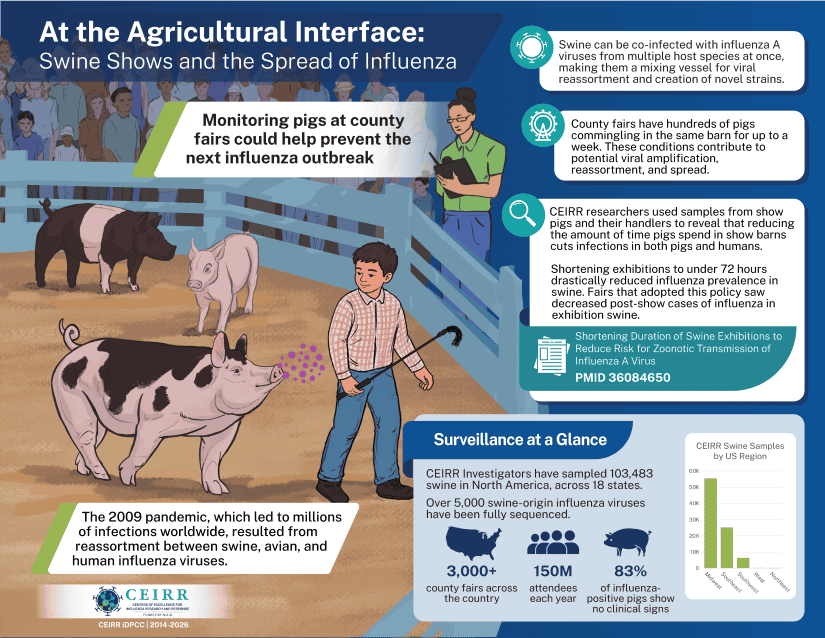
Every year ~150 million people in North America visit agricultural fairs. Though only ~1.5% of the nearly 70 million pigs in the United States are exhibition swine, these animals come from various sources and commingle with each other and the public, creating a unique dynamic to amplify influenza viruses. Researchers from the Ohio State University, a SJCEIRR institute, Andrew Bowman, D.V.M., Ph.D. and Jacqueline Nolting, Ph.D., lead influenza surveillance in exhibition swine to identify and characterize these viruses.
Swine are important hosts for influenza viruses as they can be co-infected with influenza A viruses (IAV) from multiple host species. For example, the 2009 H1N1 pandemic virus originated from a North American swine IAV that was derived from avian, human, and swine influenza virus lineages. Agricultural fairs in which hundreds of pigs are cohoused and on display to the public create a unique dynamic in which IAVs may spill over into humans. Risk assessments have found that fairs with greater than 200 swine were more likely to include IAV-positive pigs, suggesting that reducing the number of pigs housed together would decrease the prevalence of influenza virus. Through the CEIRR Network, Drs. Bowman and Nolting and their teams perform surveillance of agricultural fairs to identify circulating IAVs and mitigation strategies to limit their amplification and transmission. Their research found that limiting swine exhibitions to less than 72 hours significantly reduced influenza prevalence, and fairs that adopted this policy saw decreased post-show cases.
How Did They Start Studying Influenza in Swine?
Both Dr. Bowman and Dr. Nolting are faculty at The Ohio State University in the Department of Veterinary Preventative Medicine, though neither set out to become experts in swine influenza. Dr. Bowman was a veterinary practitioner in the food animal practice at the onset of the 2009 H1N1 pandemic and was contacted by Richard Slemons, D.V.M., Ph.D., Professor Emeritus at The Ohio State University College of Veterinary Medicine, about pursuing a Ph.D. project evaluating influenza in swine. This project was the origin of using county fairs as a source of swine surveillance.
Upon completing her Bachelor's degree, Dr. Nolting joined Dr. Slemons' laboratory where she put her expertise in PCR into practice for wild bird surveillance on a one-year contract. As Dr. Nolting says, “My one year turned into a lot of years.”
The Human-Swine Interface
Since 2011, more than 500 spillover IAV cases from swine to humans have been reported, and the vast majority were linked to swine contact at agricultural fairs. Human-swine transmission is an extremely active, bidirectional interface. Not only can IAVs "jump" from swine to humans, but many swine IAVs originate from humans. While humans have limited diversity of circulating influenza viruses, pigs maintain co-circulation of many IAVs. This may be for a variety of reasons, such as host species differences or husbandry practices, but this wide variety of swine viruses is a potential source of novel IAVs that could spill over into humans.
Though swine are an important reservoir for potential novel influenza virus introduction into humans, as Dr. Nolting says, “When we think about the thousands of people that are involved in agricultural fairs, to have 500 cases over the last 10 or 20 years, it’s a drop in the bucket... Alternatively, in order for those cases to be diagnosed and documented, a lot has to happen.” Detection and diagnosis of a variant case requires the infected person to feel unwell enough to seek care, for medical providers to test for influenza--usually outside of the virus’s seasonality as most agricultural fairs occur in the summer--and for the sample to be sequenced, identified, and reported. Dr. Nolting believes the risk to humans from exhibition swine is low but emphasizes the importance of human surveillance cohorts to identify variant cases that may otherwise go undocumented.
Exhibition swine surveillance also informs commercial swine production. Viruses circulating and reassorting in exhibition swine can be compared to commercial swine to understand the flow of viral strains between the two. Evaluating human variant cases and performing serology to identify antibodies against specific IAVs are used to identify spillover events. This information is then used to implement appropriate mitigation measures and select vaccine virus strains.
Building a Surveillance Community
Establishing a surveillance program is not as simple as going into the field and taking samples. According to Dr. Bowman, “Folks not involved in surveillance underestimate how many personal relationships it takes to do this stuff... It took a long time to build this project from the ground up of winning over fair organizers and folks who do that, and it takes a lot of maintenance of those relationships.” The ability to sample pigs and humans requires buy-in from the people organizing and hosting the shows and the people raising and showing the pigs. Providing education and sharing surveillance findings back with the exhibition swine community ensures long-term investment in the project. As Dr. Nolting says, “Most of my job is extension, and to me this is what extension is. Taking biological data, taking our surveillance data, and then turning it into information that can be useful to the people who are raising the pigs.” This give and take has allowed the program to expand beyond surveillance into experimenting with different mitigation strategies to protect swine and human health and underscores the importance of mutually beneficial relationships between researchers and the community. In the words of Dr. Bowman, “I think as we design other surveillance projects, if you want long-term maintenance we’ve got to make certain that it’s a two-way street.”
These relationships have allowed Drs. Bowman and Nolting and their team to gather a wealth of data in the years since the 2009 H1N1 pandemic. The way swine surveillance is conducted has changed over the years as these data are used to target sampling strategies and answer additional questions. By implementing data-driven surveillance, resources are used more economically to go where the viruses are. Dr. Bowman does caveat this approach, noting that, “We tend to go where we know we’ll find virus, which does somewhat limit the questions we can answer. We’re heavily biased toward finding virus... There’s a whole lot more out there.” Though Dr. Bowman and Dr. Nolting can’t sample every pig at every agricultural fair, their work has been critical to understanding influenza virus dynamics in exhibition swine and improving animal and human health.
To read more about this topic, check out:
- McBride DS, et al. (2022) Shortening Duration of Swine Exhibitions to Reduce Risk for Zoonotic Transmission of Influenza A Virus. Emerging Infectious Diseases. 28(10): 2035-2042.
- McBride DS, et al. (2021) Tracing the Source of Influenza A Virus Zoonoses in Interconnected Circuits of Swine Exhibitions. The Journal of Infectious Diseases. 224(3): 458-468.
- Szablewski CM, et al. (2024) Evolution of influenza A viruses in exhibition swine and transmission to humans, 2013-2015. Zoonoses Public Health. 71(3): 281-293.
- Additional CEIRR publications on influenza in swine.