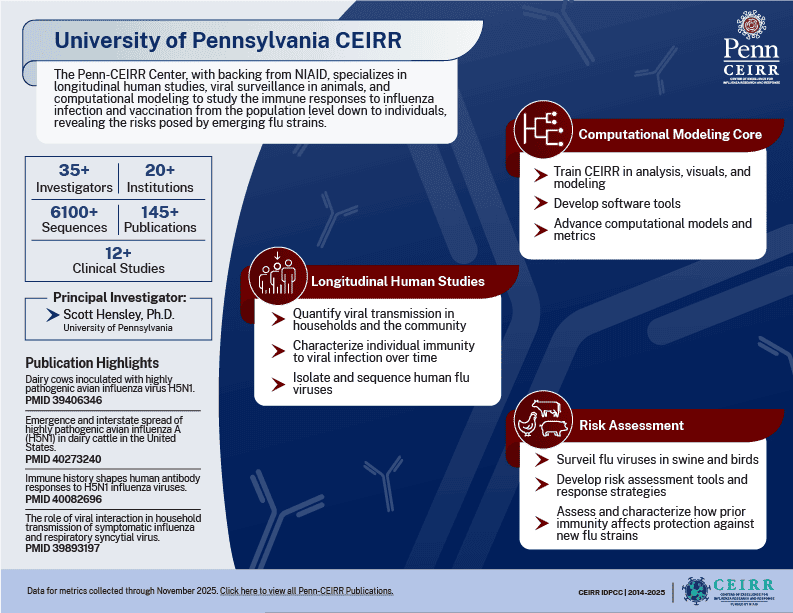
The CEIRR Network is composed of seven multidisciplinary and collaborative research Centers focused on unraveling influenza virus transmission, pathogenicity, and ecology to support public health and mitigate the impact of influenza infection. University of Pennsylvania CEIRR (Penn-CEIRR) contributes to this mission through its specialization in longitudinal human studies, viral surveillance, immunology, and computational modeling to better understand immune responses to influenza vaccination and infection and the risks posed by emerging flu strains. Headed by Scott Hensley, Ph.D. of the University of Pennsylvania, and in collaboration with institutions across the United States, Asia, and the United Kingdom, Penn-CEIRR drives research in three key areas that contribute to a deeper understanding of influenza virus evolution and immunity:
- Longitudinal Human Studies
- Risk Assessment
- Computational Modeling Core
The story of Penn-CEIRR is rooted in collaboration. When assembling his research group 15 years ago, Dr. Hensley says he dreamed of running a CEIRR Center. He found many of his research goals aligned with CEIRR’s (then CEIRS) mission and established strong, enduring partnerships to answer them. Today, many PIs within Penn-CEIRR are collaborators from his days as an Assistant Professor. With over 35 investigators across more than 20 institutions Dr. Hensley says, “I think we assembled a terrific group of creative researchers that work well with each other.”
Penn-CEIRR combines experimental and computational methods to better understand the epidemiology, immunology, and evolutionary biology of influenza viruses. This includes collecting data from over 10 clinical studies, including longitudinal human cohorts, to evaluate viral transmission within households and communities, analyze individual influenza immunity, and isolate and characterize human-derived influenza viruses. Additionally, Penn-CEIRR surveils influenza viruses from swine and birds to inform risk assessments and response strategies. The Penn-CEIRR has a strong computational program that integrates data generated throughout the CEIRR network. The marriage of these approaches enables Penn-CEIRR to:
- Evaluate antigenic drift of influenza viruses
- Assess immunity against emerging influenza virus strains
- Understand how childhood exposure to influenza viruses shapes immune responses to seasonal and emerging strains later in life
- Characterize variation in immune responses to influenza vaccination
- Develop new influenza vaccine strategies and platforms
To date, Penn-CEIRR has generated over 145 publications and 6,100 influenza genomic sequences.
The utility of these approaches is demonstrated by Penn-CEIRR's recent efforts to respond to new, antigenically drifted subclade K H3N2 viruses that have been circulating in humans. Using a combination of methods including high-throughput neutralization assays, serology techniques, and electron microscopy-based polyclonal epitope mapping (EMPEM), Penn-CEIRR successfully characterized the specificity of immune responses to these antigenically drifted viruses to enable effective influenza infection mitigation. As Dr. Hensley says, “Near real-time assessment of antigenically drifted strains is critical for choosing effective vaccine strains for upcoming influenza seasons.”

Looking toward the future, Dr. Hensley believes ongoing collaboration will be key for the continued success of the CEIRR Program, stating “CEIRR has a terrific network of scientists that can respond to any emerging threat, such as a new drifted H3N2 variant or an entirely new subtype that infects livestock leading to human infections. It is critical for CEIRR to foster collaborations between scientists with diverse interests so that we can continue our mission of decreasing the toll caused by influenza virus infections.”
The iDPCC interviewed Dr. Scott Hensley to learn more about his experiences:
1. Who/what inspired you to go into science in general?
I thought that I was going to be a professional basketball player up to ~18 years of age, at which point I realized I wasn’t very fast or tall, and I couldn’t jump high. I didn’t consider science until a bit later in life, but after I worked in a lab as an undergraduate I became hooked.
2. Do you have advice for early career scientists on career longevity in research?
Have fun and pursue questions that you think are interesting.
3. Do you have any hobbies or special interests that you'd like to share?
I like playing tennis and coaching my son and daughter’s basketball teams.
4. What is your favorite country to attend a conference… or a vacation?
Spain
5. Are you a morning person or a night person?
Night