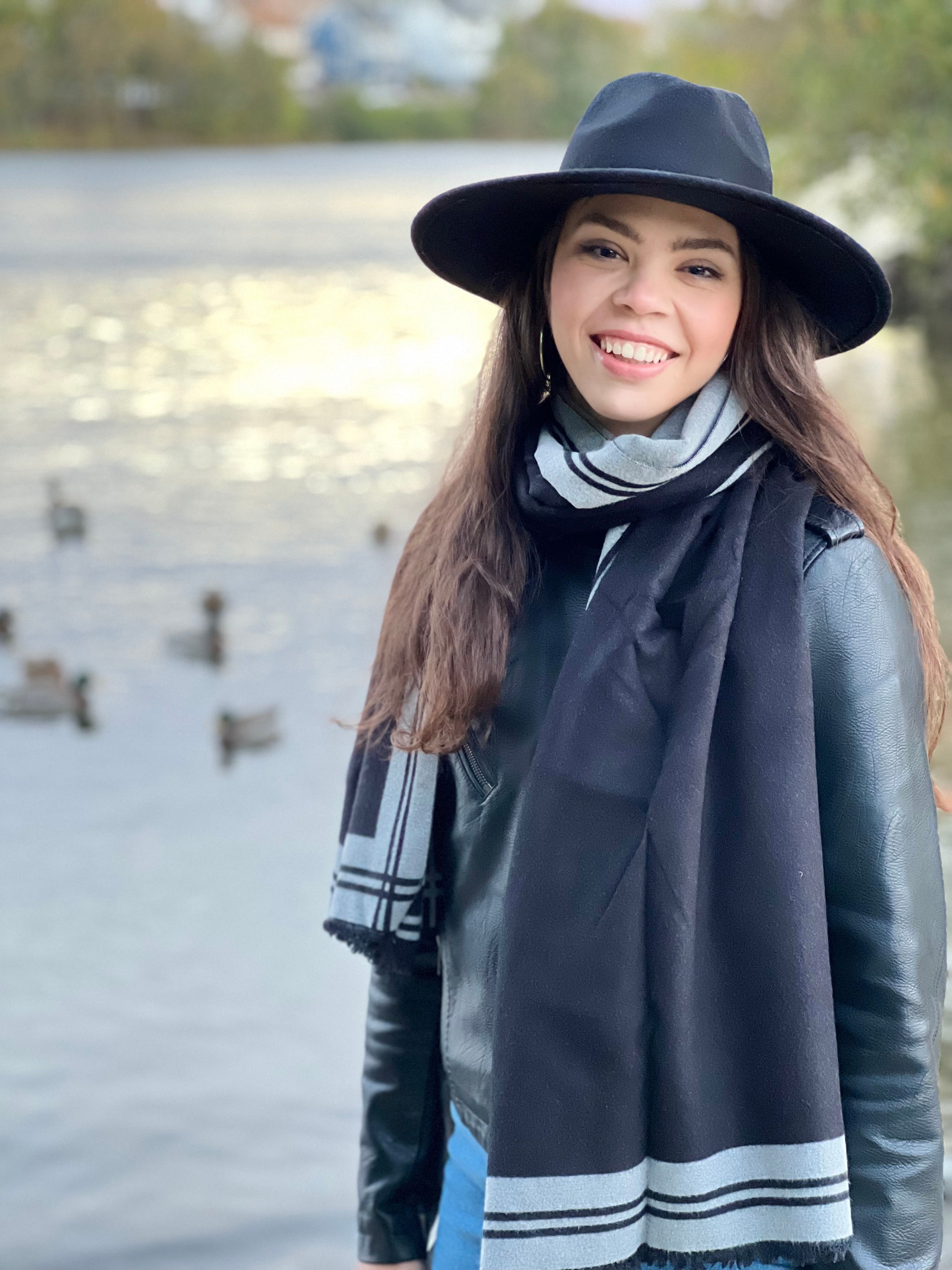
The iDPCC is pleased to continue our 5th Annual CEIRR Network Meeting (ANM) Poster Winner Spotlight Series with Anastasija Cupic! Anastasija Cupic is a Ph.D. student in the Garcia-Sastre Lab at the Icahn School of Medicine at Mount Sinai. Cupic was awarded First Place in the H5/Risk Assessment and Data Management category for her poster titled “Development of hMX1 knock-in mice for zoonotic influenza risk assessment.”
Zoonotic influenza viruses remain a continuous global health threat. One key barrier for zoonotic influenza spillover to humans is evasion of the myxovirus resistance protein A (MxA) encoded by the MX1 gene. MxA targets the viral nucleoprotein to limit viral replication. Human influenza A viruses (IAVs) have adapted to partially evade MxA, but avian IAVs lack these adaptations making them susceptible to MxA. Therefore, to assess the risks posed by avian IAVs, it is critical to accurately model MxA-dependent virus restriction.
Cupic’s research leverages in vivo models to better understand MxA-mediated virus restriction by generating CRISPR-engineered human MX1 knock-in mice. These mouse lines include wildtype MxA and clinically relevant loss-of-function MxA variant knock-ins. Cupic found that wildtype MxA expression restricted avian, but not human, influenza in vivo, with expression leading to increased survival. In contrast, mice expressing variant MxA displayed decreased resistance to avian IAV. As Cupic concludes, “Together, these data establish a humanized MxA mouse platform that enables mechanistic interrogation of host restriction and provides a robust tool for improving zoonotic influenza risk assessment.”
The iDPCC asked Cupic to share more about her scientific goals and interests:
1. How has the CEIRR Program benefited your scientific training?
A: The CEIRR Program has provided funding to my mentors, Adolfo Garcia-Sastre and Lisa Miorin, to pursue our project. I especially enjoyed the CEIRR Annual Meeting because it was a great opportunity to present our work and network with incredible colleagues in the field.
2. What motivates you to study your current research project(s)?
A: Compared to conventional laboratory mouse strains, our model more closely recapitulates human innate immunity to influenza viruses. Improving our understanding of virulence factors and host response to zoonotic influenza viruses can aid in the development of more effective surveillance, risk-assessment, prevention, and control strategies.
3. What impact do you hope your current research project will have?
A: We hope that our human MxA-expressing mice and ex vivo tools will be used to complement existing risk-assessment strategies for emerging zoonotic influenza viruses.
4. How have your career interests and plans changed over time?
A: During my college years, I initially wanted to pursue medicine but my time as a technician during the COVID-19 pandemic showed me that the work we do as researchers plays an important role in public health, pandemic preparedness policy, and patient care. This led me to pursue a Ph.D. focusing on viral and host determinants of pathogenesis, specifically with SARS- CoV-2 and Influenza.
5. What are your plans following your training?
A: Following the completion of my Ph.D., I plan to pursue a postdoctoral fellowship to further expand my expertise in virus-host interactions. I am passionate about and advocate for advancing biosafety and pandemic preparedness policy, which I plan to continue throughout my career.
6. What’s one thing you wish you knew when you started your research?
A: One thing that I always tell my students is that patience and precision are very important to conducting quality experiments. And to take good notes!
7. What is your favorite assay or technique?
A: I would have to say that it’s a tie between western blot and plaque assay! Western blot was the first technique that I learned as an undergraduate in Adolfo’s lab and at this point I can probably do it with my eyes closed. Getting the perfect exposure in the dark room is an art. On the other hand, plaque assay requires meticulousness that is satisfying for a perfectionist like myself.
8. Do you have any hobbies or special interests that you'd like to share?
A: A fun fact about me is that I am a black belt in Tang Soo Do and a recreational bodybuilder.