The final 5th Annual CEIRR Network Meeting (ANM) Poster Winner in the spotlight series is Dr. Brady O'Boyle! Brady O’Boyle is a postdoctoral fellow in the Bowman Lab at SJCEIRR. Dr. O’Boyle was awarded First Place in the Surveillance category for his poster titled “Genomic Surveillance Reveals Critical Nodes for Influenza A Virus Spread Among Exhibition Swine at Agricultural Fairs.”
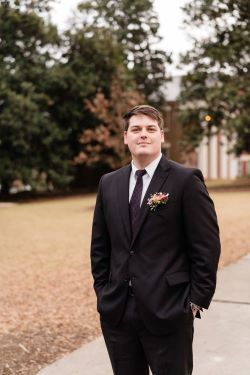
Thousands of people visit agricultural fairs annually where they come into contact with exhibition swine. Therefore, understanding the dynamics of virus transmission at the swine-human interface is critical for reducing biosecurity risks. Dr. O’Boyle’s work aims to identify agricultural fairs with elevated viral transmission. To do so, he performed phylogenetic and transmission modeling on genomic sequences isolated from exhibition swine across the Midwest and southern United States from 2022 to 2025. Using this data, Dr. O’Boyle was able to identify fairs with multiple virus introductions and track virus dissemination to other agricultural fairs. As he says, “These findings highlight opportunities for targeted interventions and underscore the need for enhanced surveillance to mitigate zoonotic risk at agricultural exhibitions.”
The iDPCC asked O’Boyle to share more about his career and his interests:
1. How has the CEIRR Program benefited your scientific training?
A: The CEIRR Program has been indispensable in expanding my cross training. Before CEIRR I considered myself just a Bioinformatician and I did mainly structural biology. During my time working with CEIRR members I have become an interdisciplinary scientist. My work on influenza transmission in exhibition swine with Dr. Martha Nelson, Dr. Jacqueline Nolting and my mentor, Dr. Andrew Bowman, have trained me in more advanced bioinformatic techniques, such as phylodynamics, as well as virology, epidemiology, public health, and animal science.
2. What motivates you to study your current research project(s)?
A: I enjoy the explorative aspects of science and there is no better place to explore than the boundaries of the animal-human interface. It feels like spelunking, finding a new strain or a new reassortant and following it back to its origins. The excitement and wonder of discovery is what keeps me motivated.
3. What impact do you hope your current research project will have?
A: I hope my work will emphasize the importance of bio-security as a One Health strategy that benefits both sides of the human-animal interface.
4. Who/what inspired you to go into science in general?
A: Funny enough, Punnett Squares. I was in middle school when I was first introduced to Punnett Squares. The idea that these small diagrams could predict something as abstract as phenotypes set me on my path to becoming a researcher.
5. What is one thing on your bucket list?
A: I have always wanted to visit the 7 wonders of the natural world, the first one on my list is to see the northern lights.
6. How have your career interests and plans changed over time?
A: When I was in undergrad I planned to be a geneticist, that’s even what my degree is in. Then I worked in a lab where we were looking at snake venom and I remember that PI nudging me to do a PhD instead of stopping at my bachelors. I decided, why not? It was the best “Why not?" moment and the rest has been history.
7. What are your plans following your training?
A: I am keeping myself open to opportunity following my training. I couldn’t have imagined I’d be doing my current work a year ago, so I don’t want to limit myself by imagining what I’ll do 2 years from now. Currently I’m very interested in modeling transmission networks of animal origin viruses, as well as evaluating how viral genomic and proteomic diversity contribute to host specificity.
8. What’s one thing you wish you knew when you started your research?
A: I wish I knew that so much of your research career relies upon you setting your own guidelines. You have to be your own compass to navigate the academic landscape.
9. What is your favorite assay or technique?
A: I’m a visual learner, so I enjoy using sequence logos and phylogenetics to visualize differences between sequence datasets.
10. Do you have any hobbies or special interests that you'd like to share?
A: I’m a big Magic the Gathering fan, specifically the commander format.